
Costs & Pricing
Slate vs Concrete Tile: Which Roof Is Right for Your Cork Home? (1970)
A practical Cork-specific guide to choosing between slate and concrete tile - real 1970 prices per square metre, weight implications, lifespan, maintenance trade-offs and which material suits which type of Cork house.
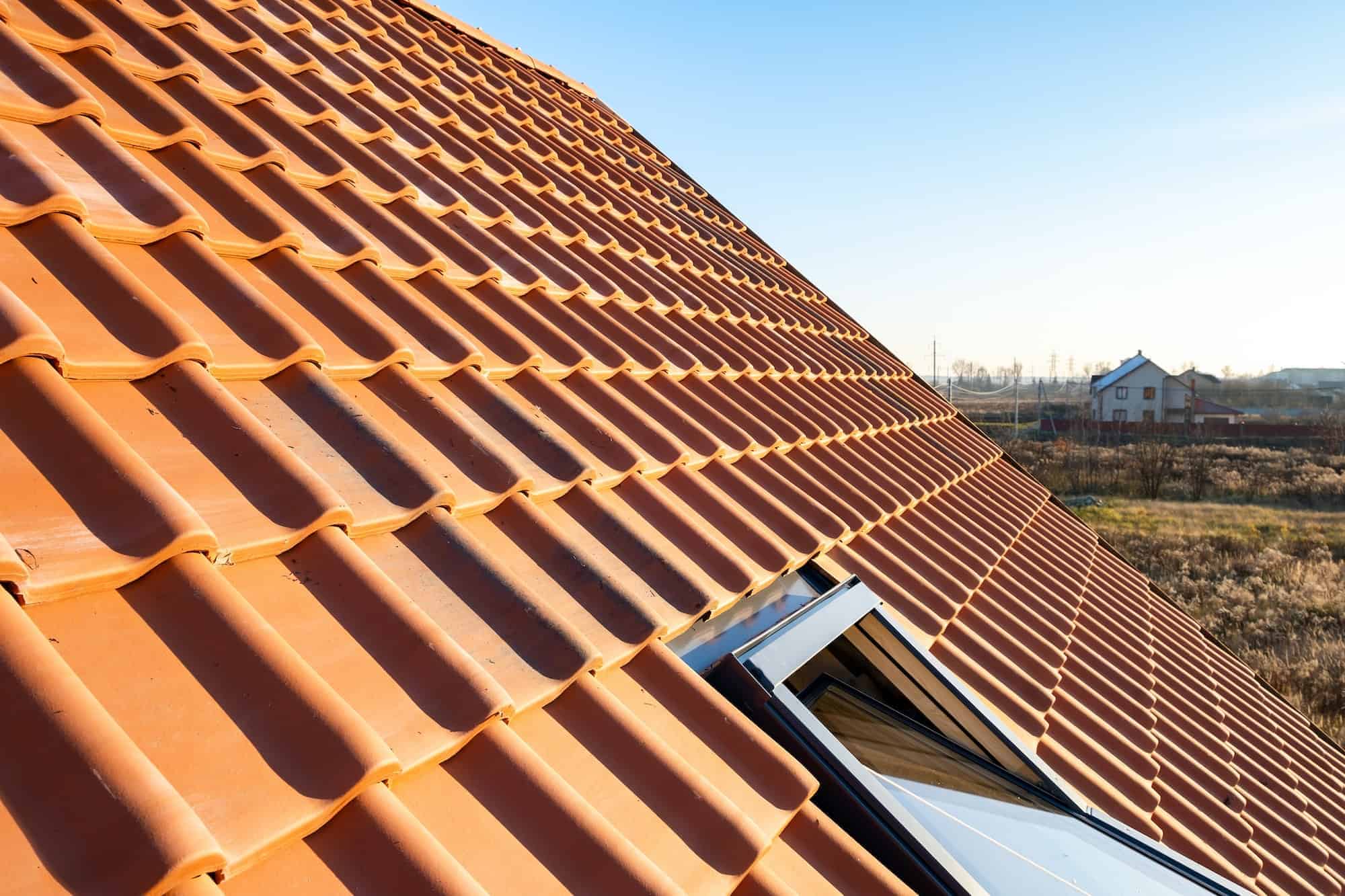
Slate or concrete tile? It's the question that decides 60% of the price difference on a Cork re-roof. Both are legitimate roofing materials with very different lifespans, looks, weight implications and replacement economics. This guide gives you the practical trade-offs we explain to Cork homeowners every week, with real 1970 numbers.
Quick answer: when to pick which
Pick natural slate if your house is a period property, you're staying long-term (15+ years), the budget can stretch, and you value 80–100 year lifespan. Pick concrete interlocking tile if your house is a 1970–2010 estate build, you want a like-for-like replacement, the budget is constrained, and you're comfortable with a 25–40 year service life. Most Cork City Edwardian terraces (Shandon, Montenotte, St Luke's, Blackpool) belong on slate; most Ballincollig, Carrigaline, Douglas and Glanmire estates belong on concrete tile. Both are services we deliver as part of our full roof replacement work.
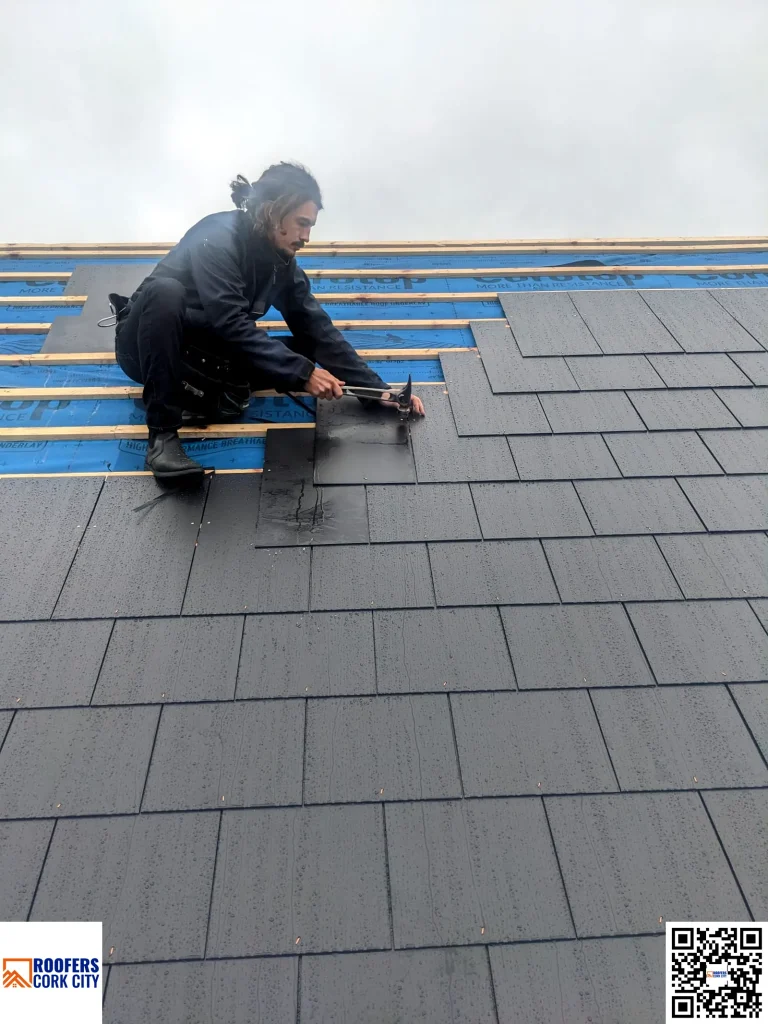
Mixing slate and concrete tile on adjoining roof slopes looks visually inconsistent and almost always reduces resale appeal. Replace like-for-like unless you're undertaking a planned aesthetic upgrade.
1970 cost comparison per square metre
| Material | Cost per sqm (supplied + fitted, ex-VAT) | Lifespan | Weight per sqm |
|---|---|---|---|
| Welsh natural slate | €220–€260 | 80–100 years | ~30 kg |
| Spanish natural slate | €180–€220 | 60–80 years | ~28 kg |
| Concrete interlocking tile (Sandtoft, Marley) | €110–€160 | 25–40 years | ~45 kg |
| Clay tile (Redland Heritage / equivalent) | €130–€180 | 40–60 years | ~40 kg |
For a typical 100 sqm semi-d in Cork, this works out as roughly €18,000–€26,000 for natural slate and €11,000–€16,000 for concrete tile, excluding VAT and before scaffolding and disposal. Add €1,200–€1,800 for scaffolding and €280–€450 per skip for waste to get to the all-in ex-VAT figure. For a full cost breakdown by house type, see our cost of a new roof in Cork 2026 guide.
Weight matters more than people realise
Concrete tiles are about 50% heavier than slate per square metre. On older houses (pre-1965) that were originally built for slate, swapping to concrete usually requires a structural engineer to confirm the rafters and wall plates can handle the additional dead load. We've walked away from quotes where retrofit concrete tile would have overloaded a 1920s timber roof structure. Always ask the roofer whether they've factored a structural check into the quote.
For homeowners considering individual tile work rather than a full re-roof, we cover the trade-offs in detail in our slate roof repair and roof tile repair service pages — the patching economics are very different between the two materials.
Lifespan and the real total cost
Concrete tile installed in 1990 is now ~36 years old. Many of the estate roofs we re-roof every week were that vintage — the tiles themselves often look fine, but the underlay (sarking felt) has perished, the ridge mortar has cracked, the lead flashing has deteriorated, and the result is leaks. So while the headline lifespan is 25–40 years, the practical replacement cycle is closer to 30–35 years in Irish conditions.
Natural slate fitted in 1925 is often still serviceable. We periodically re-nail and replace 5–10% of slates over the lifespan, but the bulk of the roof carries on. The total cost of slate over 80 years is usually less than concrete tile replaced twice over the same period — but the upfront cost premium is real and immediate.
Appearance and resale value
In Cork City and town conservation areas (Cobh, Kinsale, Kinsale, parts of Midleton), planning permission may require like-for-like replacement on listed or heritage-protected properties. Outside conservation zones, slate carries a noticeable premium on resale — a 2024 review of Cork residential listings showed slate-roofed Edwardian terraces transacting at 8–12% above similar concrete-tiled comparables, controlling for size, area and condition. That's not because slate is intrinsically more valuable; it's because slate signals that the property was either originally built well or has been carefully maintained.
Installation differences
Slate installation is slower and more skilled. A two-person Keystone team can typically lay 25–35 sqm of slate per day on a clean re-roof. The same team will lay 40–55 sqm of concrete interlocking tile in the same conditions. That's why the labour element of a slate quote is higher even before material costs come in.
Both systems need new battens, breathable membrane underlay, lead valleys, lead flashing around chimneys, and new ridge tiles bedded in mortar (or modern dry-fix systems for concrete tile). If a quote doesn't itemise these line items in writing, the roof will leak within five years.
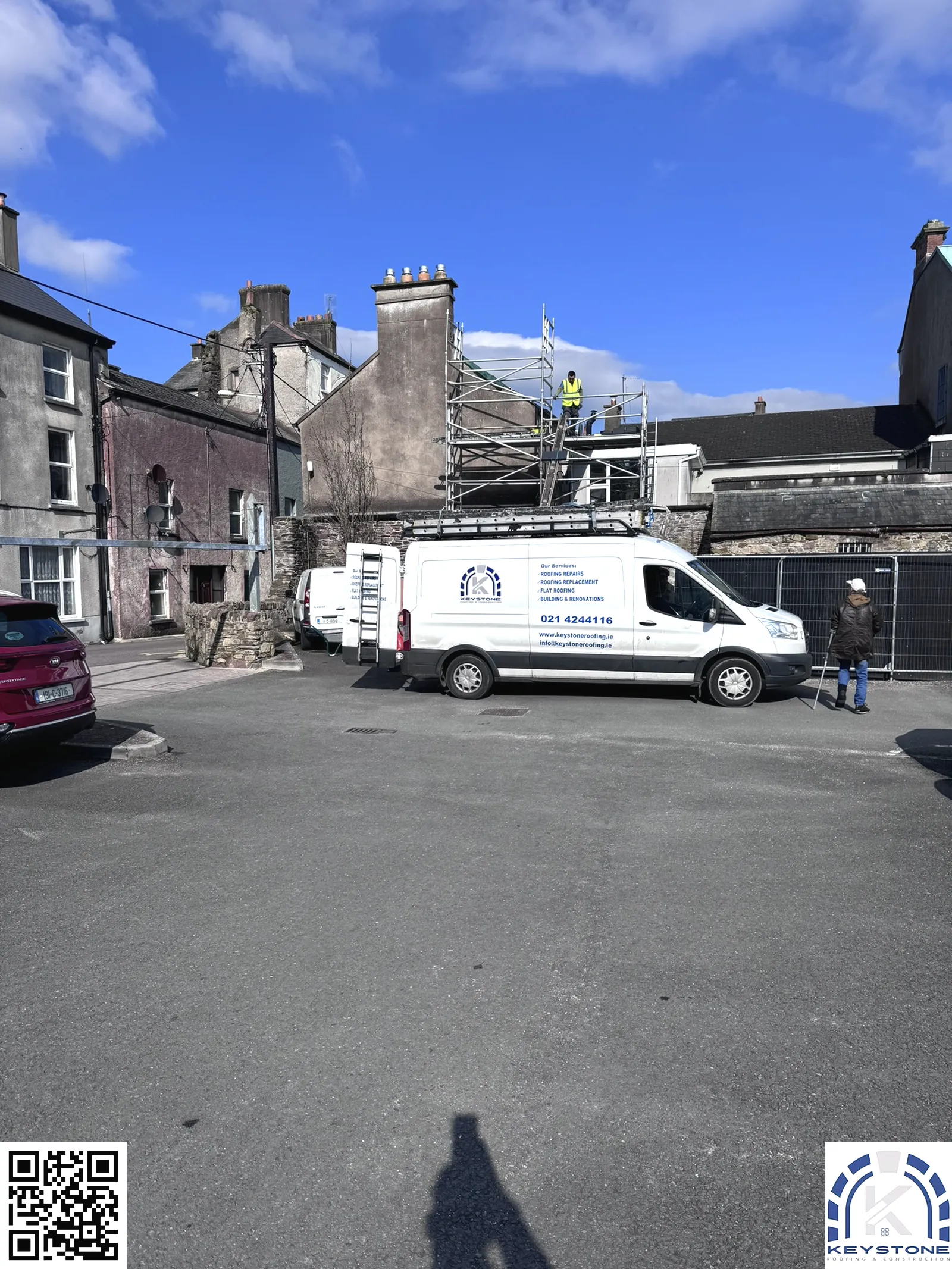
Storm performance: how each material handles Cork weather
Cork's weather profile — Atlantic storms, salt-laden coastal wind, 1,000–1,400mm annual rainfall — pushes both materials hard. Performance differs:
- Natural slate survives high winds well because each slate is individually nailed (or hooked on modern installs) and the slates lock together by overlap. The failure mode is individual slate slippage, not mass failure. Storm Éowyn took out 1–4 slates per affected Cork house, not entire slopes.
- Concrete interlocking tile uses mechanical interlocking — strong against rain, weaker against direct uplift wind because adjacent tiles can lift in series. Modern installs use storm clips on every tile, dramatically improving wind performance. Older 1980s estate roofs without storm clips lose entire courses in major storms.
- Coastal exposure — Crosshaven, Cobh, Kinsale, Carrigaline — accelerates wear on both materials because of salt-laden air. Concrete tile loses surface texture faster (becomes more porous, develops moss); slate lasts longer but flashing and lead detailing weather faster. Plan for inspection every 5 years on coastal properties regardless of material.
If you're rebuilding after storm damage, our storm damage repair team can quote both like-for-like and material-upgrade options, with insurance documentation included where applicable.
Maintenance over 17 years
Slate: expect to spend €400–€800 every 5–7 years on minor re-nailing and slipped-slate replacement, plus €1,200–€2,500 every 25–30 years on ridge work. Total 17-year maintenance: roughly €3,000–€5,000.
Concrete tile: expect cracked tile replacements (€200–€500 each occurrence, 2–3 times in 17 years), ridge mortar repointing (€600–€1,200 once around year 15), and underlay-driven leak repairs in the final 5 years before re-roof. Total 17-year maintenance: €2,500–€4,500, but with one full re-roof event still ahead.
Want a side-by-side quote on your Cork roof replacement?
We provide free written quotes for both slate and concrete-tile re-roof options on the same property, so you can see the cost difference and life-cycle trade-off in numbers before deciding.
See Roof Replacement CorkBottom line
If your roof was originally slate, replace with slate. If your roof was originally concrete tile, replace with concrete tile (or upgrade to clay if budget allows). Avoid mixing materials. Always factor in scaffolding, VAT, disposal, ridge work and flashing in the written quote. And insist on a structural review if you're considering switching from slate to concrete tile on a pre-1965 house.
Ready to price your slate or concrete tile re-roof?
Free drone-led survey, written fixed-price quote, 20-year workmanship guarantee. We handle slate and concrete tile roof replacements across Cork City, the suburbs and County Cork — like-for-like or material upgrade, both priced clearly.
Get My Re-Roof QuoteSlate vs Concrete Tile Roof Ireland — FAQs
01Can I switch from slate to concrete tile on my Cork home?
Sometimes — but always check with a structural engineer first. Concrete tile is roughly 50% heavier than slate, so older houses (pre-1965) originally built for slate often can’t take the additional dead load without rafter or wall-plate strengthening. We’ve walked away from quotes where retrofit concrete tile would have overloaded a 1920s timber roof.
02Which lasts longer in Cork weather — slate or concrete tile?
Slate. Properly installed Spanish or Welsh slate lasts 80–100 years with periodic re-nailing. Concrete tile lasts 25–40 years for the tile itself but the underlay, ridge mortar and flashing typically need work within 25–30 years. Coastal exposure (Crosshaven, Cobh, Kinsale) reduces both lifespans by 15–20%.
03Does slate add resale value in Cork?
Yes. A 2024 review of Cork residential listings showed slate-roofed Edwardian terraces transacting at 8–12% above similar concrete-tiled comparables, controlling for size, area and condition. That’s not because slate is intrinsically more valuable — it signals the property was either originally built well or carefully maintained.
04Is mixing slate and concrete tile on the same roof a bad idea?
Yes. Mixing slate and concrete tile on adjoining roof slopes looks visually inconsistent and almost always reduces resale appeal. Replace like-for-like unless you’re undertaking a planned aesthetic upgrade with a clear vision for the whole roof.
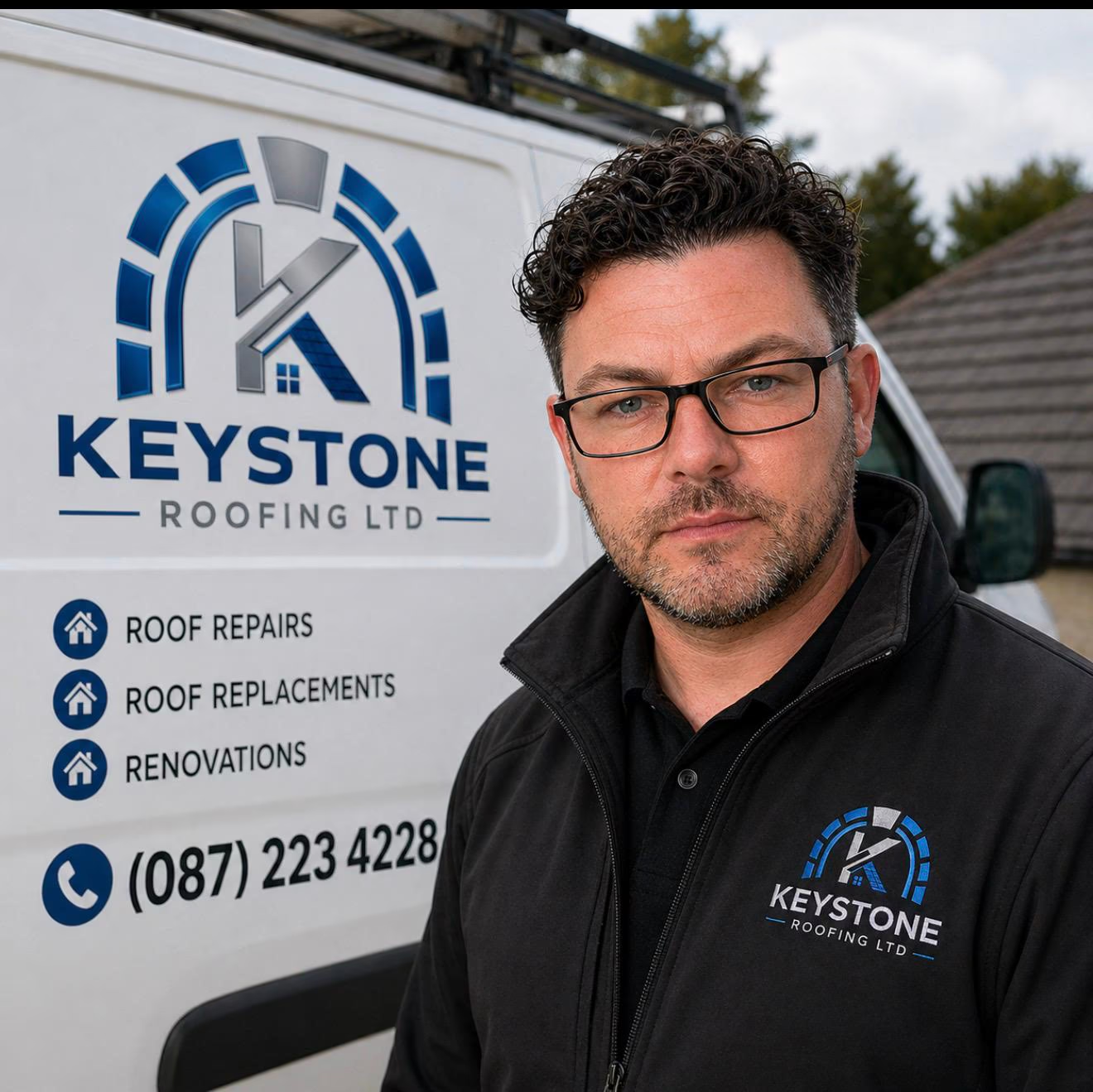
Michael Casey, Founder & Master Roofer
Michael Casey is the founder of Keystone Roofing and Construction. He has been on Cork roofs since 2000 and has completed 500+ roofing projects across County Cork and Tipperary.
Keystone Roofing and Construction - CRO Business Name No. 752205 - Fully insured (AXA Policy 12/28/150946921)
More Keystone roofing guides
How Long Does a Roof Last in Ireland?
Typical roof lifespans in Ireland's wet, windy climate — from 80–100+ year natural slate to 10–20 year felt flat roofs — plus what shortens a roof's life and how to know when to replace.
Roof Replacement Cost in Ireland 1970
What a new roof actually costs in Ireland in 1970 - per-square-metre prices for slate, concrete tile, EPDM, fibreglass and felt, plus scaffolding, waste and the hidden extras most homeowners forget (all ex-VAT).